A Powerful Lesson
By Lucie Lehmann
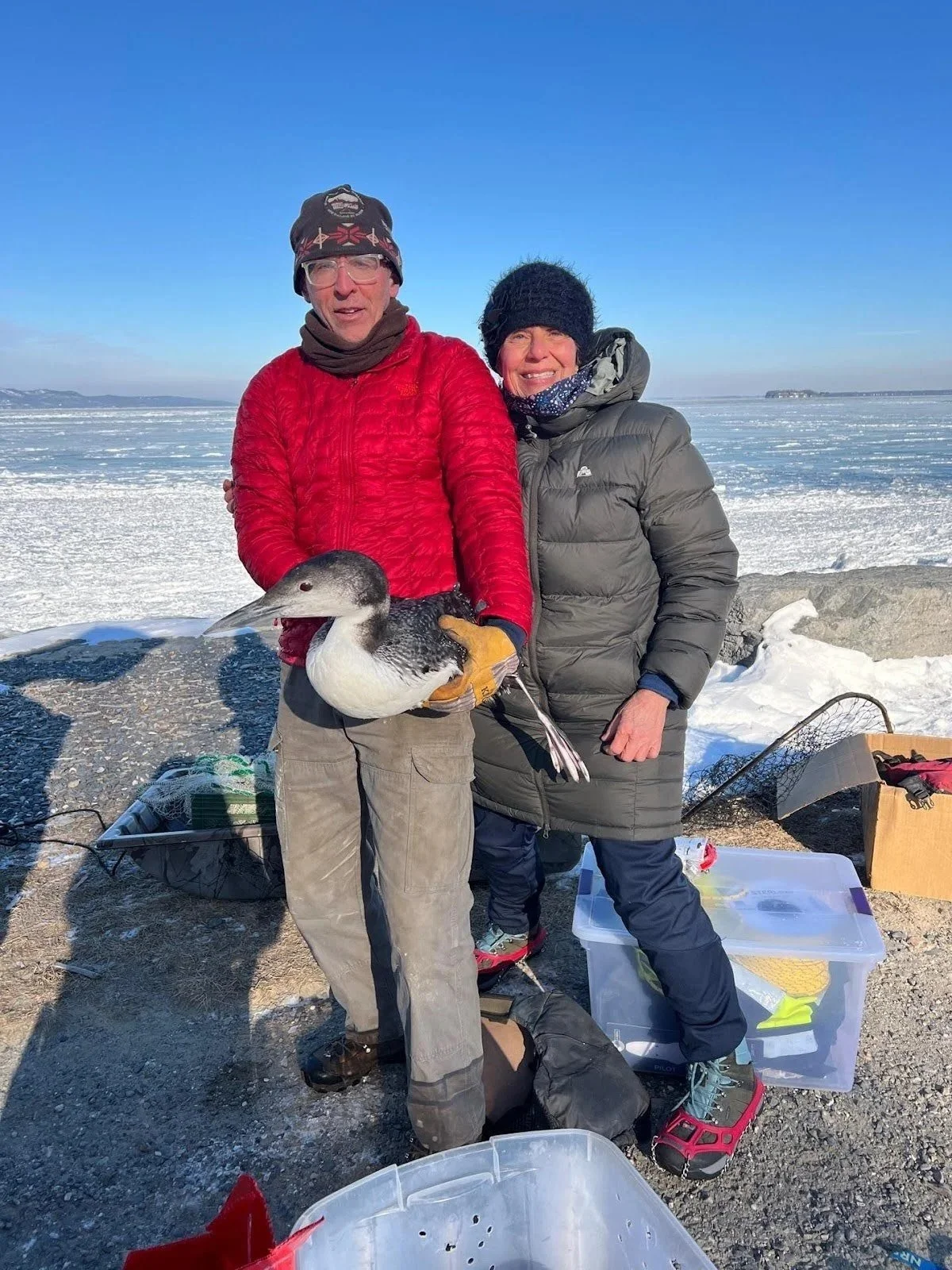
VCE Biologist Eric Hanson and Lucie Lehmann with a rescued loon on Shelburne Farms
Nature has always been my best teacher. The other day, it reminded me, painfully but beautifully, that conservation successes are hard won, measured in tiny increments, and result from tireless work, usually over long periods of time. It reinforced, too, that each of us has a role to play in bringing them about—some admittedly more skillfully than others, as I witnessed firsthand—but a role, nonetheless.
On my habitual walk on Shelburne Farms on a recent frigid Saturday, I scanned the almost solidly frozen lake. My eyes settled on two dark specks in a tiny pool of open water about a hundred feet from the wall. When I raised my binoculars and looked, my heart sank. The specks were Common Loons, two of them, one larger than the other. As I watched, the bigger loon flapped furiously and lifted itself out of the water, landing heavily on the ice like a curling stone. For a full minute, it flapped and scooted on its belly, presumably towards a larger patch of open water hundreds of feet out. The other bird, meanwhile, remained in the pool, either unable or too scared to follow. It began vocalizing, its plaintive tremolo echoing over the groaning ice. The bigger loon stopped, then turned itself around and slowly returned to the edge of the water, slipping in silently to rejoin its companion.
I knew the only thing keeping that water open was the motion of the loons diving, and that the already minuscule patch would grow smaller as the temperatures continued to fall. Even if both of them managed to get out onto the ice eventually, the loons would likely die, possibly from predation from the local eagle watching from a nearby pine, exhaustion, or simply because there wasn’t sufficient open water left to give them their needed running room—up to ¼ of a mile—to take flight.
I immediately called the Vermont Center for Ecostudies to report the stranded loons. That set in motion a three day series of phone calls and emails between me and Eric Hanson, VCE’s renowned and revered loon biologist; multiple daily monitoring visits to check on the loons as we worked on a plan and assess the shrinking pool; fruitless in-person attempts to enlist the Shelburne Police and Volunteer Fire Department; my eventual connection with Vermont Fish & Wildlife’s Northwestern District’s intrepid and highly competent Game Warden, Sergeant Dana Joyal, who not only went out on the ice and deemed it safe for a rescue attempt, but agreed to help with it; and invaluable assistance from Craig Newman, who runs the raptor center at Shelburne Farms and who also kept an eye on the loons and volunteered for the rescue. Finally, everything fell into place for the following Tuesday morning.
It was minus seven when I left my house, the blueberry muffins that I had baked at 5:00 a.m. cooling in a container, my stomach in a knot. Thankfully, the loons had survived another night in the kiddie pool-sized opening, and I called out to them that help was finally on its way. Eric arrived at eight, having left Craftsbury in minus-17-degree temperatures 90 minutes earlier, followed by Craig and then Dana. We moved the impressive mound of materials that Eric brought with him–seine nets, carriers, towels, and plastic sleds—down onto the ice. He and Dana put on their dry suits and walked out toward the birds, while Craig and I remained closer to the shore as backup and to avoid upsetting the pair more than necessary.
The agitated loons dove as the men approached and set the net. Within a minute, however, the larger loon resurfaced and became entangled in it. Eric and Dana quickly pulled the net up and skillfully extricated the loon, placing it in a carrier and signaling for us to come and get it. It all seemed so easy, so perfectly choreographed and executed. Relief and exhilaration flooded my body, reaching almost to my frozen toes. Within minutes, Craig and I made our way back to the shore with the rescued bird as Eric and Dana reset the net. We were so busy transferring the loon to a different carrier, putting it in Eric’s car, draping it with a towel, and talking with the small knot of people that had gathered, that we failed to register that the second loon hadn’t resurfaced. By the time we finished and returned to the ice, nearly ten minutes had passed with no sign of the remaining loon, far too long for it to have survived underwater. Slowly, Eric and Dana retrieved and folded the net and gathered up the remaining items, their voices low, their faces pained. Eric shook his head as he approached us. I wanted to believe that the second loon had somehow found its way under the ice and out to the open water, holding its breath for several minutes as loons can do, but even before Eric later admitted that he had seen its body under the ice close to the hole, I knew it wasn’t true.
It is as hard at moments like that to summon joy as it was to persist in getting help. Eric, who told me he had seen hundreds of dead loons in his career, was nonetheless affected by the loss of the second loon, though he knew better than any of us how risky and even dangerous it was—for the loons as well as the humans— to attempt that kind of rescue. We all knew intellectually that we couldn’t guarantee a good outcome, just a good effort, but we wanted so badly to believe it could happen. I wanted to believe it. For three days, I had monitored the loons, willing them to hold on, promising them I would bring help. It stung more bitterly than the cold to know that one of them had been left behind.
And yet.
What I experienced that Tuesday morning was a heroic effort that succeeded in saving a loon, a beautiful, feisty, mature loon, not the inexperienced juvenile that we first assumed and that the other bird likely was. A loon whose very existence was possible only because of the extraordinary work that Eric and other scientists and volunteers at VCE and allied conservation organizations undertook over many years to bring loons back from the brink of extinction in Vermont. As the large bird vigorously protested its final transfer to a bigger transport carrier, Eric mused that had this been thirty years ago, saving that one loon would have meant saving ten or twenty percent of the total population in the state. Ten or twenty percent. Even today, with loon numbers rebounding in Vermont, VCE estimates that there are still only 115 breeding pairs in Vermont. Saving that one loon had made a real difference.
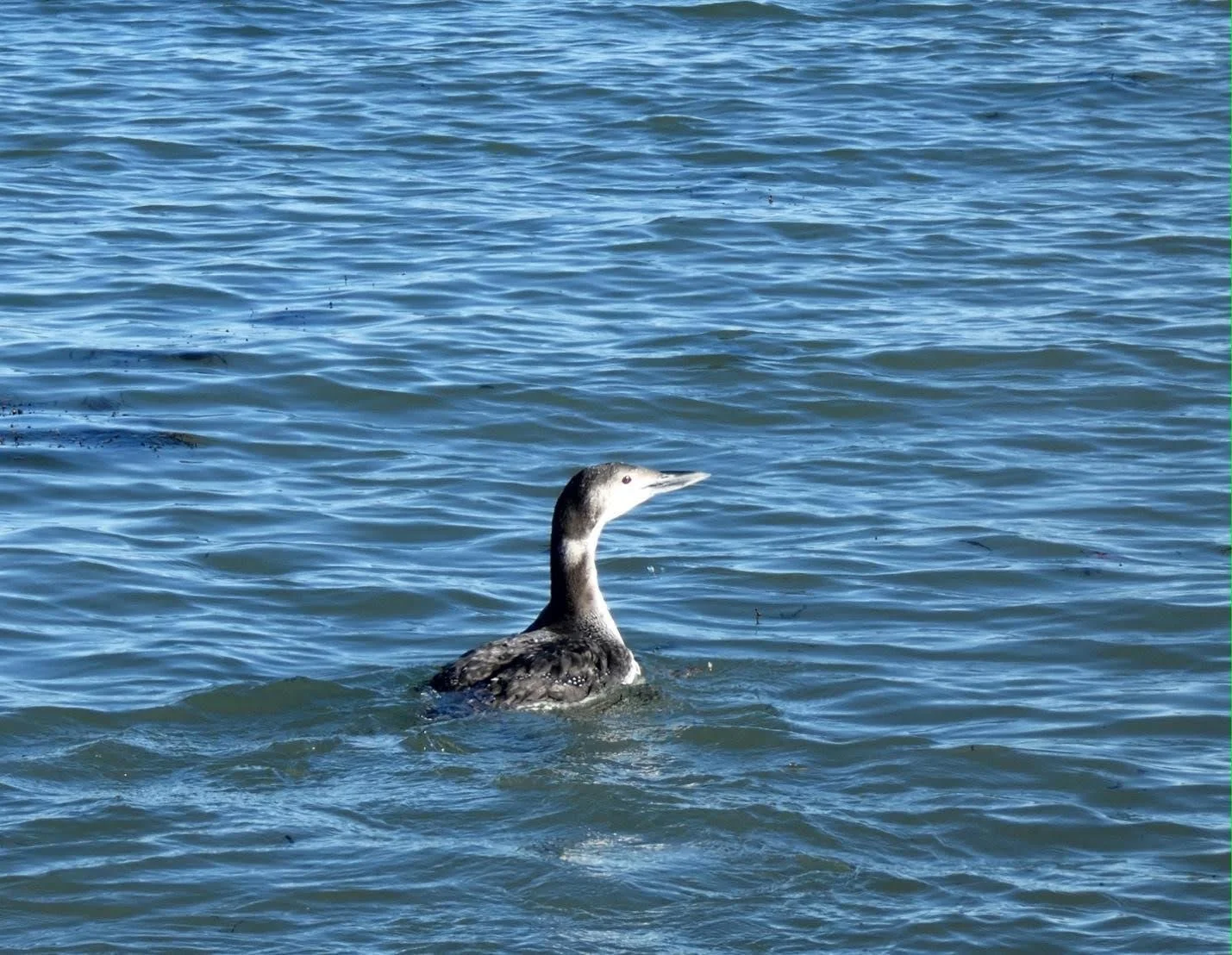
After all that he had already done, Eric drove to Portsmouth, NH, to release the loon into the Atlantic Ocean. At the end of the day, I rejoiced at the pictures he sent of it swimming freely, and read as Eric described how eagerly the loon swam far out into the open water before even once flapping its wings. When I thanked him again, Eric turned it around and wrote that “it’s people [like you] out there that make all these good things possible.”
I sat with his words for a long time. The sting of disappointment had faded as slowly as the chill in my body. But he was right, of course, not about me in particular, but about all of us. It will take everything we have, working together, to continue to make real progress for the loons, for conservation, for our beleaguered planet. It will be frustratingly slow and painful and only occasionally beautiful, but we cannot close our eyes to what is sometimes literally right in front of us. As James Baldwin wrote, “Not everything that is faced can be changed, but nothing can be changed until it is faced.”
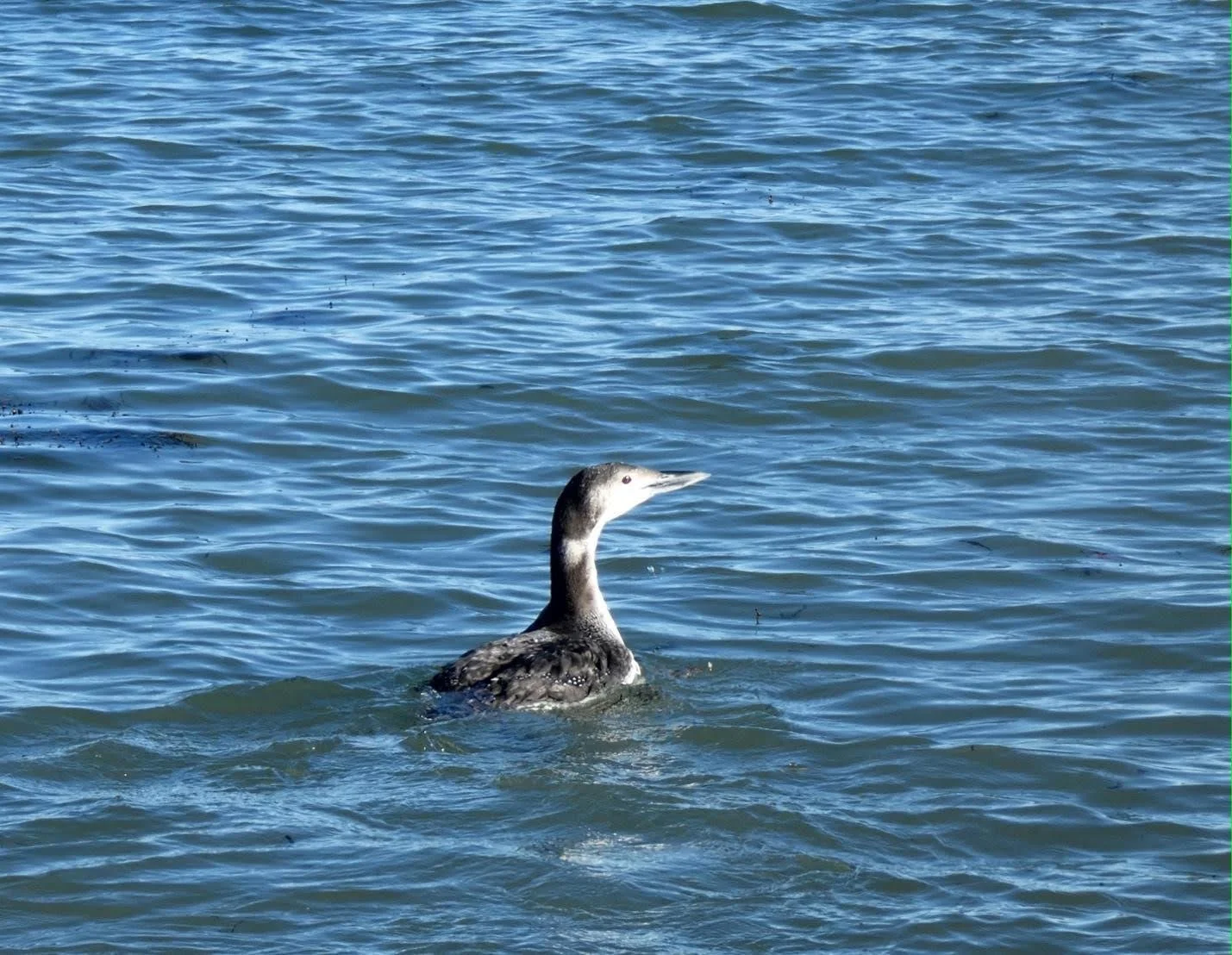
The released loon swimming in the Atlantic Ocean.
If you are interested in learning more about VCE’s work and supporting loon conservation in Vermont, go to their website, www.vtecostudies.org, and navigate to their Loon Conservation Project page.