Galapagos-The Enchanted Isles

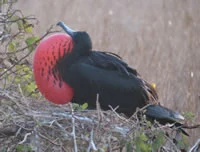
Magnificent Frigatebird

Far off the coast of Ecuador, straddling the equator, lies an archipelago of storied islands-the Galapagos. In 1835 Charles Darwin visited the Galapagos during his historic voyage on the HMS Beagle. In 1859 Darwin published his theory of natural selection based on his observations in the Galapagos more than twenty years earlier. Since then, the Galapagos Islands have attracted naturalists, scientists, writers, and the just plain curious (also known as tourists), drawn to the archipelago by its unique, diverse species.

The Galapagos Islands (literally the Islands of the Tortoises) are especially attractive to birders visiting the archipelago partly for historical reasons, but especially to view the unique diversity of birds and other creatures produced by natural selection on isolated islands as reported by Charles Darwin over a century ago.

Recently, our own Shirley Johnson presented a program entitled Galapagos-the Enchanted Isles based on her own voyage to the Galapagos. In her presentation Shirley showed photographs of the plants, animals, scenery, and, naturally, birds that inhabit the Galapagos, accompanied by lively commentary. She and her husband Bob photographed many of the fabled Galapagos birds-albatrosses, boobies, frigatebirds, penguins, and, of course, the Galapagos finches made famous by Darwin's journals. She discussed the symbiotic relationship between certain birds, like ground finches and Galapagos tortoises. These birds remove ticks and other annoying ectoparasites from the tortoise's skin with the full cooperation of the reptile. Similarly, she described the close link between the habitat of the Galapagos and the birds that live there. The nesting and feeding habits of the Cactus Finch and the prickly pear cactus, Opuntia, provided but one example. Finally, Shirley demonstrated the diversity that exists from island to island that Darwin recorded so long ago. The four species of endemic mockingbirds served as a fascinating example. Unlike the finches, Darwin had the foresight to label each of the mockingbird species he collected according to its island of residence. Later, Darwin recognized that speciation of these mockers correlated with the fact that they were able to breed in isolation, allowing their unique characteristics to emerge. 

Most of us will never visit the Galapagos Islands, except vicariously. This program reminded us of the singular importance of the Galapagos in the history of science, evolution, and conservation.

Magnificent Frigatebird photo by Bob Johnson.

Saving Bolton Valley Nordic

In February, 2011, the public learned that most of the land encompassed by the Bolton Valley Nordic Center would be sold to a private investor and that public access to the extensive trail system would be lost. In less than two months a group of community members formed the Friends of Bolton Valley Nordic and Backcountry to protect this resource and maintain public access to it. This group of over 200 concerned citizens reached out to the Vermont Land Trust, which, in February, 2012, signed a contract to purchase this 1161 acre tract for $1.85 million. A grant of $800,000 from the Vermont Housing and Conservation Board was obtained, leaving $1,050,000 to be raised from local fundraising. This fundraising campaign is in progress.

Ovenbird

Ovenbird

What's at risk? With over 90 kilometers of groomed and backcountry trails, the Bolton Valley Nordic Center is one of the three largest trail systems in Vermont. In fact, it's base elevation is the highest in Vermont. The Catamount Trail runs through the property and the trail system connects with many other routes, including those at the Trapp Family Lodge, Mount Mansfield State Forest, Underhill State Park, and Little River State Park. These trails are used throughout the year by colleges, universities, and public schools for outdoors events. Furthermore, the land and trails are heavily used by community groups as well as individuals, providing recreational access for people of all ages and ability levels. It is noteworthy that nearly half of Vermont's population lives within 30 miles of this property. The outpouring of enthusiasm for the Save Bolton Nordic project is a testimony to the widespread support for public access to this land.

Bolton Valley Nordic provides critical wildlife habitat, as well, connecting two large blocks of state land, Mount Mansfield State Park and Camel's Hump State Park. The land also includes the headwaters and much of the watershed of Joiner Brook, which feeds into the Winooski River. As a result, the Chittenden County Uplands Conservation Project has designated this property as their highest priority for conservation. 

What about the bird life at Bolton Valley Nordic? The birds inhabiting Bolton Valley have not been formally identified, though the habitat likely provides breeding territory for a variety of thrushes, vireos, flycatchers, and warblers among others. To address this issue, the Green Mountain Audubon Society, lead by Board member Liz Lee, conducted monthly bird walks on the Broadway Trail through August and created a preliminary species list for Bolton Valley Nordic. We hope that this effort will increase public awareness of the value of this land and will support the VLT fundraising campaign. For more information about the Save Bolton Valley Nordic project consult the Vermont Land Trust website at http://www.vlt.org/bolton or call 802-262-1241.

Bolton Valley Bird List

American Woodcock Brown Creeper Yellow-Warbler
Ruffed Grouse Winter Wren  Yellow-rumped Warbler 
Broad-winged Hawk Ruby-crowned Kinglet  Louisiana Waterthrush
Red-tailed Hawk American Robin  Cedar Waxwing
Mourning Dove Hermit Thrush  Scarlet Tanager 
Northern Flicker Swainson's Thrush  Indigo Bunting 
Yellow-bellied Sapsucker Wood Thrush  Northern Cardinal 
Downy Woodpecker Veery  Rose-breasted Grosbeak 
Hairy Woodpecker Red-eyed Vireo  Purple Finch 
Eastern Wood-Pewee Blue-headed Vireo  American Goldfinch 
Least Flycatcher American Redstart  Pine Siskin 
Great-crested Flycatcher Blackburnian Warbler  Chipping Sparrow 
Olive-sided Flycatcher Blackpoll Warbler  Song Sparrow 
Yellow-bellied Flycatcher Black-throated Blue Warbler   White-throated Sparrow
Eastern Phoebe Black-throated Green Warbler  Dark-eyed Junco 
American Crow Black-and-white Warbler  Red-winged Blackbird
Blue Jay Canada Warbler Common Grackle 
Common Raven Magnolia Warbler  Ruby-throated Hummingbird
Black-capped Chickadee Mourning Warbler   
Tufted Titmouse Nashville Warbler   
White-breasted Nuthatch Ovenbird    
Red-breasted Nuthatch Chestnut-sided Warbler  

Bird Habitat and Invasive Plants: A Morning at Geprags Park

markgeprag25.jpg

Geprags Park is a well-known birding spot in Hinesburg. People are drawn to the park for the variety of species that can be found there, including rarities such as Golden Winged Warblers. What is less noticed by many birders is the slow and steady progress of invasive plant species altering this important habitat.

On June 11, 2011 the Hinesburg Conservation Commission and Hinesburg Land Trust hosted a workshop at Geprags Park to highlight the importance of managing the habitat for birds and the negative impact of invasive species on critical habitat. Sharon Plumb Invasive Species Coordinator for the Vermont Nature Conservancy and Mark LaBarr from Audubon Vermont lead 27 participants into the field on a rainy Saturday morning. Mark set up mist nets and banded several birds that he caught. He explained the importance of the early successional shrubland habitat for many of the priority species that nest at Geprags. In addition to Golden-winged Warblers and Blue-winged Warblers, these include Eastern Towhees and Brown Thrashers. Mark works to protect these species and the shrubland habitat that supports them as part of Audubon’s Champlain Valley Bird Initiative. Audubon is partnering with the Hinesburg Conservation Commission,  Hinesburg Land Trust, and the Vermont Nature Conservancy to maintain the shrubland habitat at Geprags by managing against invasives and for native shrub species.

sharongeprag25.jpg

Mark’s banding demonstration was followed by a presentation by Sharon Plumb that highlighted the problems that invasive plant species pose for bird habitat. Many birders are unaware of the habitat loss that birds face due to invasive plants. Invasive plants also decrease the available food supply for birds. The buckthorn at Geprags, the predominant invasive species in the park, is an example of what can happen to bird habitat if invasive plants are not controlled.

Invasive plants outcompete native plants and in the worst case, can become a monoculture.  Many invasive plants bloom earlier and retain their leaves longer than native plants. Some are favored in landscaping because deer do not browse them. These plants then spread out from landscaped yards. Conversely, native plants tend to be overbrowsed, thus giving the invasives a larger foothold. 

For birds this altered habitat has several consequences. Many of our native plants evolved as hosts to native insect species. When invasive plants overrun an ecosystem, they disrupt an entire food chain. Native insects are less common in a habitat that is overrun by invasive plant species, having evolved with the native plants for food, egg laying and shelter.

Likewise, birds may eat the seeds and berries from invasive plants, but these plants have less nutrition than the native fruits and seeds. Unfortunately, birds also carry seeds of invasive plants to new locations.

At Geprags Park, the invasive species were mapped this past summer with the help of the Vermont Nature Conservancy and volunteers. A management plan will be written. From there, on-the-ground control of invasive plants and habitat restoration will begin.  When an infestation of an invasive plant reaches the level of the buckthorn at Geprags, complete eradication of a species is very difficult. Eliminating manyof the plants and staying on top of the infestation is often the best course of action. 

Birder’s can help stop the spread of invasive plants by looking at the landscaping on their property as well as identifying invasive plants in their fields and forests.  A small infestation is much easier to eradicate than waiting until the plant is out of control.  An excellent resource is the gallery of invaders illustrated at http://www.vtinvasives.org/, which helps to identify invasive plants and explains the best ways to eliminate them.  This website also offers native alternatives for landscaping. 

The invasive plant issue at Geprags Park illustrates the importance of not just conserving land for birds, but also keeping native ecosystems intact for nesting and feeding.

Photos of Mark LaBarr banding birds and Sharon Plumb with the workshop participants courtesy of Melissa Levy.  Thanks to Mark LaBarr for input on this article.

Restoring Endangered Species: Lessons From Puffins and Terns

twoPuffins_200.jpg

Humans have devastated seabird colonies in many parts of the world by excessive hunting for food and feathers and introducing mammals such as cats and rats to othrwise secure nesting sites.

Worldwide, 23% of all seabird species are now globally threatened as marine pollution, coastal development, and rising sea levels due to climate change take their toll. Although seabird nesting islands seem safe due to their remoteness, they are intimately connected to human activities. For example, Maine's seabird nesting islands are affected by large populations of Herring Gulls and Great Black-backed Gulls that benefit from garbage and fishing waste hundreds of miles away. As populations of these scavengers increase, they deter smaller migratory seabirds such as puffins and terns from nesting on many of their historic nesting sites. Ironically, Bald Eagles and Peregrine Falcons, the products of other successful wildlife restoration programs, now threaten rare Maine seabirds such as Great Cormorants and Roseate Terns.

Dr. Stephen Kress

Dr. Stephen Kress

Last November, Dr. Stephen Kress, the Director of the National Audubon Society's Seabird Restoration Program and the founder of Project Puffin in 1973, reviewed the techniques that he and others have developed on Maine's coastal islands that have lead to the restoration of puffins and terns on their historic nesting sites. Techniques developed in Maine have been adopted worldwide. For example, in Vermont, social attraction and the use of tern decoys, techniques developed in Maine, have been critical to the success of Audubon Vermont's Common Tern Restoration Project on Lake Champlain.

Dr. Kress entertained a large audience at the Billings Center on the UVM campus, describing the evolution of Project Puffin and the many obstacles he encountered in the process of re-introducing puffins to Maine. Despite the success of the program on East Egg Island and Seal Island, Dr. Kress emphasized that many challenges to the puffin population persist and that without human intervention these colonies would in all likelihood fail. The audience applauded his commitment to the seabird restoration program and responded enthusiastically to his plea for continued support of Project Puffin

To Catch a Loon

Captured Loon.jpg

In late May Audubon member Jim Morris reported that a Common Loon had appeared on a tiny stormwater retention pond located between capturing a loonShaw's supermarket and Friendly's restaurant at Tafts Corner in Williston. For the next few months this loon attracted the attention of hundreds of observers, including representatives of the Vermont Fish and Wildlife Department. The hope was that the bird would be able to leave the pond on its own; but no, it seemed to be perfectly content to stay put, subsisting on the healthy goldfish population swimming in the pond. Unfortunately, this loon was stuck.

Enter Eric Hanson, the Vermont Center for Ecostudies expert on Vermont's loons and the leader of the Loon Recovery Project in Vermont. On a warm July evening Eric, his summer intern Shannon Maes, and five volunteers (Jim Wallace, Carl Runge, Jim Morris (Yes, that Jim Morris), Maeve Kim, and Bruce MacPherson) gathered to plot the capture and release of this imprisoned creature. This proved to be no easy task. The loon was skittish, diving at every opportunity, and not necessarily a willing participant in this caper. But Eric had a plan-in fact, two plans. Plan A involved launching a 12 foot aluminum boat on this little pond, powered by a small electric motor. Using a one million candlepower spotlight to "freeze" the bird and a taped loon call to attract her attention, Eric planned to approach the loon carefully and scoop her up in an oversized fish net. Easier said than done. Plan B involved stretching a gill net, provided by VT F&W across the pond, trapping the bird in the folds of the net. Really!

As darkness fell, we gathered the equipment for this improbable adventure at the edge of the pond. After launching the boat, Jim Wallace steered toward the loon, Shannon held the spotlight, and Eric turned on a recording of a yodeling loon, the male territorial call. The rest of us held our collective breath. At first the loon was leery, but in a few minutes she became interested in the intruder's call and allowed the boat to approach her. In a moment-swoosh-it was over. The loon was engulfed in the net and was swiftly transferred to a padded cardboard box for safekeeping.

Onshore, Eric carefully collected basic data about the bird, determining that she was somewhat smaller than most Lake Champlain loons. Shannon held the bird's beak, while Maeve held the rest of the bird securely. Eric surmised that she might be a vagrant headed for Quebec based on her small size. While all this activity was taking place Gail Osherenko filmed the action. Gail's video now appears on her blog at http://www.vermontloonblog.wordpress.com. The rest of us looked on in awe.

In a few minutes this operation was over. The loon was placed securely back in her box for transport to Lake Champlain. Later that night she was released safely and successfully at the Burlington waterfront.

You can learn more about this adventure by visiting the Vermont Center for Ecostudies website at http://www.vtecostudies.org/. Thanks to Carl Runge for providing a photo of the captured loon.

A Bird in the Hand

BirdInHand_240.jpg

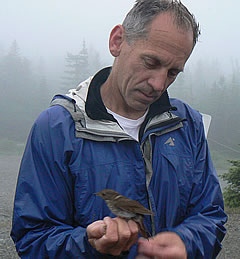
One of Vermont's iconic summer birds is the elusive Bicknell's Thrush. A resident of the spruce-fir forests found on the mountaintops of the northeastern United States and Canada, Bicknell's Thrush is a species of conservation concern as climate change slowly strangles its breeding habitat. On June 22 and 23 members of the GMAS and invited guests journeyed to the top of Mount Mansfield to meet one of the world's experts on Bicknell's ThrushBird in the hand, Chris Rimmer, founder and Director of the Vermont Center for Ecostudies. For nearly 20 years Chris and his coworkers have studied Bicknell's Thrush on its breeding ground at the top of Mount Mansfield and other Vermont mountains and on its wintering range in Hispaniola. No one is better equipped to educate us about Bicknell's Thrush than Chris Rimmer.

Even in late June the weather at the top of Mount Mansfield is unpredictable and often forbidding. Perhaps, then, it should not have been surprising to encounter dense fog, driving rain, and gusty winds when we arrived at the parking lot at the end of the Toll Road the first evening. No "dusk chorus" for us. Still, Chris was undeterred as he calmly described his research and the history and biology of Bicknell's Thrush in the montane forest. One has to admire this tough liittle bird that survives, indeed thrives, under such adverse weather conditions.

The next morning was better-a literal window of opportunity as the harsh weather temporarily subsided. At 5 A.M. we gathered in the parking lot again to learn more about Bicknell's Thrush. Chris reached into his magic bird bag and retrieved a first year, banded thrush that he had captured in a mist net earlier that morning. Patiently, Chris pointed out that these tiny thrushes travel thousands of miles in migration between Vermont and Hispaniola. One 11 year old bird that he captured on several occasions had traveled an estimated 49,000 miles in his lifetime. Incredible. After recording basic anatomical measurements from this bird (weight, length, wing length, etc.) and allowing a few minutes for photographs, Chris handed the thrush to Jo Wright. After a moment to gain his (and her) composure, the thrush zipped off into the tangle of spruce and fir trees nearby.

A few minutes later Chris released another captive bird from a mist net, a handsome, male Blackpoll Warbler. Chris went through his data gathering routine again, then handed the bird to Jo's husband Chip. The warbler seemed to be quite content resting in Chip's open palm for a few minutes, but finally was induced to return to the forest.

It was a privilege to experience the unique montane habitat at the top of Mount Mansfield, even, or perhaps especially in such inclement weather. Bicknell''s Thrush, Blackpoll Warbler, White-throated Sparrow, Dark-eyed Junco, Swainson's Thrush, and Winter Wren live and breed in these mountains. We were fortunate to spend a few hours walking the narrow trails and inspecting the mist nets to learn more about these special birds and the efforts of investigators like Chris Rimmer to conserve them.

Thanks to Shirley Zundell for her photo of Chris Rimmer holding a Bicknell's Thrush.

The Plight of the Bobolink

by Bruce MacPherson

Robert of Lincoln

Merrily swinging on brier and weed,
Near to the nest of his little dame,
Over the mountain-side or mead,
Robert of Lincoln is telling his name:
Bob-o’-link, bob-o’-link,
Spink, spank, spink;
Snug and safe is that nest of ours,
Hidden among the summer flowers.
Chee, chee, chee.

Robert of Lincoln is gaily drest,
Wearing a bright black wedding coat;
White are his shoulders and white his crest.
Hear him call in his merry note:
Bob-o’-link, bob-o’-link,
Spink, spank, spink;
Look, what a nice new coat is mine,
Sure there was never a bird so fine.
Chee, chee, chee.

                     - William Cullen Bryant

bobolink-lg.jpg

Is there any other bird so celebrated in poetry as the Bobolink? Bryant, Emily Dickinson, and many others have portrayed the wonder of Bobolinks in their poetry. Bobolinks are celebrated in music, too. In fact, an a capella singing group at Middlebury College calls itself the Bobolinks. Would anyone willingly listen to a singing group that called themselves the Middlebury Grackles. Of course not.

Bryant’s poem (and there is much more) describes Bobolinks perfectly. Bobolinks are the only North American bird that is white on the back and black underneath like a “tuxedo worn backwards”. That creamy, yellowish-white nape is unmistakable, as Bryant points out. Of course, this distinctive plumage applies only to breeding males. Females and non-breeding males are drab and buffy with stripes on the face, back, and rump, blending perfectly into their grassy habitat. Unusual among songbirds, Bobolinks undergo two complete molts each year-one molt on the breeding grounds and another on their wintering grounds. After this second molt, the males are rather drab, but the yellowish tint to their feathers rapidly wears off to reveal the stunning breeding plumage for which they are best known.

And how about that ebullient song. In spring and early summer, the Bobolink’s song rings out through the countryside. Described as “a bubbly delirium of ecstatic music” or sometimes as an imitation of the loveable Star Wars robot R2D2, song alone marks the Bobolink as a bird of distinction. In the Northeast the song of the Bobolink is as characteristic of summer as the tinkle of the bell announcing the arrival of the ice cream truck.

During breeding season Bobolinks are widespread in North America, ranging from the prairies of the Midwest to the hayfields and pastures of the northeastern United States and southern Canada. Here they build their nests on the ground, fledge their young, and molt their feathers. After a visit that seems too short, Bobolinks depart in late summer and early fall for their wintering grounds in the grasslands of Argentina, Paraguay, and Bolivia with only a stop or two along the way.

Although Bobolinks are still fairly common birds, the population has steadily declined for many years. Habitat for Bobolinks was optimal when the United States was predominantly rural and the land was cleared for farming. As agriculture declined and hayfields and meadows reverted to forest, breeding habitat for Bobolinks was lost. Furthermore, intensive hay cutting during the breeding season destroys many Bobolink nests and fledglings each year. Preservation of open grasslands and providing incentives for farmers to delay hay cutting until after the breeding season is over would help to stabilize the population of these iconic birds of summer.

All is not well for Bobolinks wintering in the southern hemisphere either. Huge flocks of Bobolinks forage in the rice fields of South and Central America (the Latin name for Bobolinks, Dolichonyx oryzivorous, means “long-clawed rice-eater”), where they are harassed by angry farmers.  Likewise, the unregulated use of pesticides in the southern hemisphere poses an additional threat to the dwindling Bobolink population.

What to do? The first step in developing a conservation plan is to learn more about the relative threats to Bobolink populations throughout their range. In this regard an investigator from the Vermont Center for Ecostudies, Dr. Rosalind Renfrew, has done seminal work, revealing the secrets of Bobolink behavior throughout their annual cycle. Dr. Renfrew’s thoughts on the plight of the Bobolink are recounted in the interview with her that follows this article.

An Interview with Dr. Rosalind Renfrew

bobolink_200.jpg

You have been studying Bobolinks for some time now. What sparked your interest in Bobolinks in the first place?

Bobolinks may be charismatic, with their bubbly song and striking colors, but what really drew my attention was their incredible migration, and the fact that we knew next to nothing about their life on the other side of it. 

The results of the 2nd New York Breeding Bird Atlas were published recently and documented a modest 8% decrease in blocks with nesting Bobolinks compared with the previous survey in 1980-85. What can you tell us about Bobolink population trends in Vermont and across the country? Are Bobolinks a Species of Special Concern in Vermont?

Yes. In Vermont the distribution of Bobolinks has not changed appreciably in the last 25 years, but where they do occur, abundance has been declining. They occupied 6 percent fewer blocks in the second Vermont Breeding Bird Atlas compared to the first Atlas. What is of more concern, however, is that the Breeding Bird Survey shows an annual decline of 2.9% for Vermont from 1982 to 2007. Vermont is part of a larger-scale trend: Bobolink populations have been decreasing by 1.8% per year range-wide since 1970, and declines have been most severe during the last 10 years. Canada has lost 88% of its Bobolink population since 1970. Because declines have continued unabated during the last 10 years and threats to populations persist, Canada added the species to its Threatened list in 2010.

Bobolinks, of course, are champion migrators. You have obtained some fascinating results concerning Bobolink migration using geolocator technology. What did you discover? What surprised you most about Bobolink migration?

Geolocators represent an innovative new technology for analyzing bird migration patterns. Small light-sensitive chips attached to captured birds record and store data based on the time of sunrise and sunset that can be evaluated with software when the birds are recaptured. The data we obtained from only three Bobolinks (2 from VT, 1 from NH) shed dramatic new light into the location and timing of migration stopovers, routes, and wintering grounds. Two birds that were breeding 7 km apart in the Champlain Valley did not winter together, nor did they share the same migration route. Each of the three birds had 2-4 stopovers per migration, and some fall stopovers lasted for weeks. The Bahamas are a short but potentially important stopover during spring migration, and Colombia and Venezuela appear to be important stopovers in the spring and fall, respectively. Although Bobolinks do move around to some extent during winter, they do remain in the same general area for 2.5-3.5 months. All three birds left their wintering areas during the first week of April to migrate north (it was previously thought that they departed in early March). These are just some of the highlights.

The biggest surprise was a transoceanic flight by one bird of 1900 km (1100 mi) within 24 hours - which means the bird flew an average of 50 mph for 24 hours. I checked and rechecked my data, and consulted with the developers of the geolocator software, and it is a certainty that the bird made this trek as part of its migration north. Undoubtedly, it had the help of a tailwind, and the weather data from the area on that day support this assumption. Even so, I never thought this species to be capable of migration speeds similar to those of shorebirds.

My colleagues and I hope to retrieve more geolocators this year that will provide insights about the migration patterns, timing, and wintering areas of populations across the breeding range.

A few years ago you discovered a huge, previously unknown flock of Bobolinks feasting in the rice fields of Bolivia and speculated that there might be more. What is the significance of this finding? Are there more mega-flocks of Bobolinks in South America yet to be discovered?

This was the first time that such enormous flocks were documented, although it was nothing new to the local farmers. After this discovery, biologists in Argentina searched in rice fields and also found large Bobolink flocks. All observations on the wintering grounds, however, collectively account for less than 5% of the entire Bobolink population; there are clearly other areas supporting wintering Bobolinks that have not been discovered. I suspect that Bobolinks also overwinter in the wetlands of the Pantanal (southern Brazil), but this area has so far only been described as a migratory stopover.

It’s hard to believe that Bobolinks are regarded as pests in South and Central America, whereas they are revered in the United States and Canada as an iconic summer bird. You have surveyed farmer’s attitudes toward Bobolinks in the southern hemisphere. What did you find? What can be done to change these attitudes?

First and foremost, it is critical to recognize that there is actually little difference in attitudes between farmers in North and South America- just different pests. A rice producer in Bolivia is no different from a sunflower producer in the U.S. struggling to keep Red-winged Blackbirds at bay. Although birdwatchers may enjoy the Bobolink, scathing remarks about the species appeared in farmers’ journals in Canada once the species was declared Threatened and had the potential to disrupt haying operations (farmers now have a 3-year exemption while a plan is developed). If you’re watching a species disrupt your operations, or literally eat into your income, probably nobody is going to change your attitude.

Attitudes in Bolivia varied depending on the farmer’s experience with the Bobolink. Newer rice farmers weren’t bothered by the birds, while those who had been fending off the species for decades tended to have zero tolerance. My sense was that estimates of the damage caused by Bobolinks were often exaggerated by the latter group, and this has been seen with other species in other countries. But the threat to farmers is very real and needs to be addressed. Determining just how much (or how little) the birds are eating may help change perceptions, and may help farmers populate a cost-benefit analysis with some real numbers.

The approach to take is not to talk farmers out of their perceptions, but rather to offer information and most importantly, attempt to develop solutions. While Canada works hard to bring back its population of Bobolinks, we need to be thinking about how to avoid exacerbating the problems for rice growers far south of us, whose control efforts may only make recovery here more difficult and expensive. The north hand needs to know what the south hand is doing, and vice versa; a holistic approach is needed.

There are threats to Bobolinks in the northern hemisphere, too, especially the timing of hay cutting that coincides with Bobolink nesting and breeding. When you look at threats to Bobolinks across the board, which ones are most important to focus on from your perspective?

Threats have so far been addressed only on the breeding grounds, and it is critical to continue to promote management practices that maximize nest productivity. Research from the Champlain Valley (carried out by Noah Perlut and Allan Strong at UVM), however, shows that even the best case scenario on hayed lands will slow but not halt declines. A study in Iowa on non-hayed lands found that to obtain self-sustaining populations of Bobolinks, increasing survival during the non-breeding season was essential. In both cases, survival is an important part of addressing population declines. We need to learn whether, how, and where we can take conservation measures to increase survival during migration and winter, while continuing to maintain and even create quality nesting habitat. In essence, a holistic approach that addresses threats throughout the Bobolinks annual cycle will be needed to get (and keep) Bobolinks back on track.